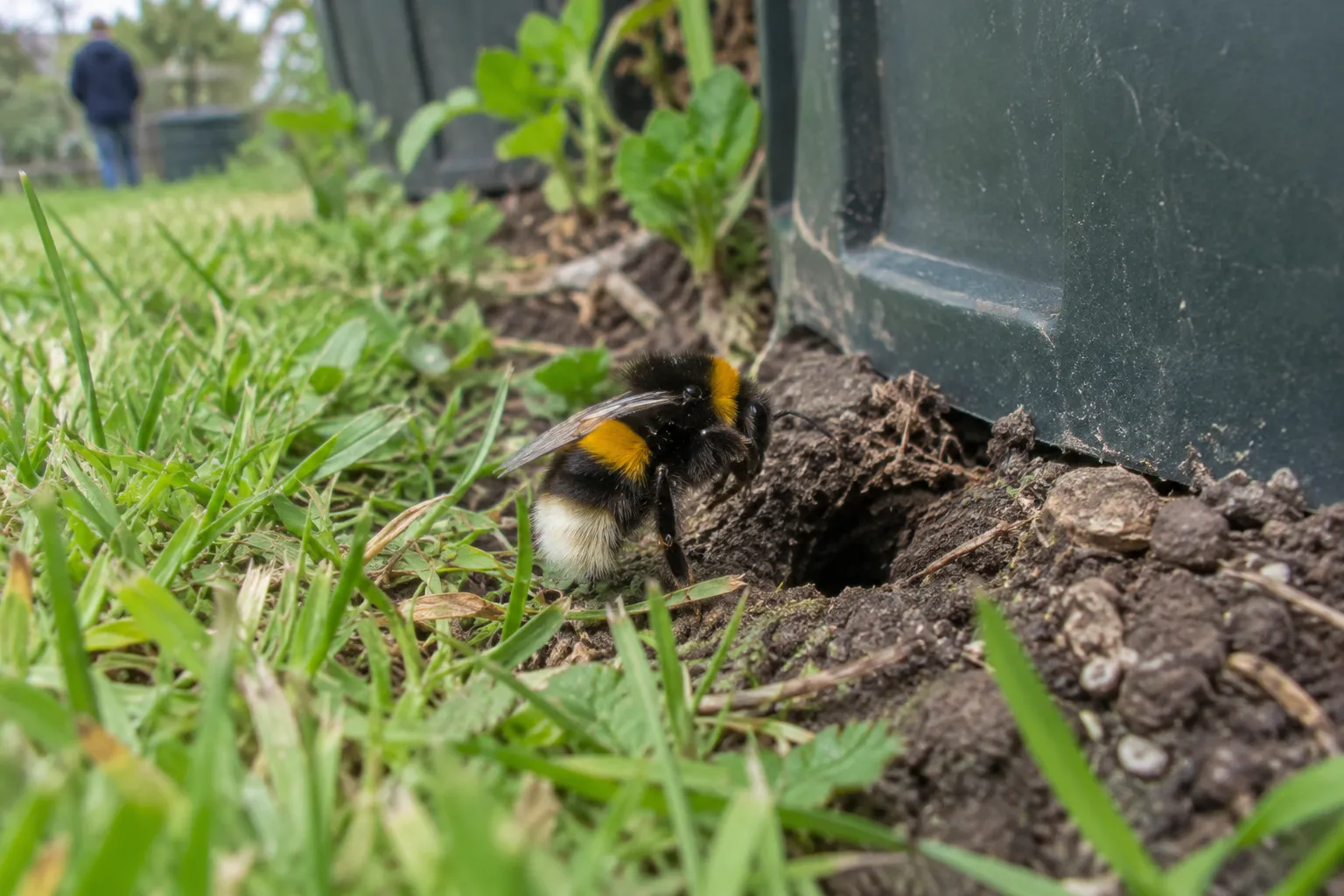
You usually don't need to remove a bumble bee nest. Bumble bees are gentle, beneficial pollinators, and a nest only lasts about two to three months before the colony dies off and new queens leave to hibernate. If the nest is away from doors, paths and play areas, the simplest answer is to leave it. If it is somewhere you can't avoid, or someone in the house is allergic to stings, a specialist can move the bumblebee nest or remove it. This page explains how to tell it really is a bumble bee nest, how long it will last, and your options. For other kinds of bees, see bee removal in Auckland.
Should you remove a bumble bee nest?
In most cases, no. The NZ Bumblebee Conservation Trust explains that bumble bees are not aggressive, only defend a nest when it is disturbed, cause no structural damage and store no honey, so nothing melts or attracts other bees. A nest is worth moving or removing only when it sits right beside a door, path, play area or workspace, or when someone nearby has a serious sting allergy.
Ask yourself three questions:
- Will people walk past or over the entrance every day? Bumble bees put up with a lot, but standing on or knocking the entrance is how stings happen.
- Is anyone in the household allergic to stings? If so, don't wait it out.
- Is the nest inside the house itself, with bees getting into rooms? That is worth sorting.
If the answer to all three is no, mark the spot, keep the lawnmower and the dog away from it, and let the colony finish its season. Seal the entrance in winter, once it is quiet, so a new queen can't use the same cavity next spring.
How can you tell it's a bumble bee nest?
Bumble bees are large, round and very hairy, usually black with yellow, orange or buff bands and a white or buff tail. A bumble bee nest is hidden, and you notice the entrance rather than the nest: a few bees going in and out of a hole in the ground, a compost heap, a wall, a gap under a shed or the base of a hedge. Traffic is slow, a handful of bees an hour.
That slow traffic is the giveaway. A honey bee nest has a constant stream of small brown bees, dozens a minute. Wasps are smooth and shiny, black and yellow, with a narrow waist, and a wasp nest is usually far busier.
Common nest sites in Auckland gardens:
- Old mouse nests and rabbit burrows in the ground
- Compost heaps and grass clipping piles
- Under sheds, decks and houses
- Inside walls, roof spaces and old furniture left outside
- Bird boxes and wood piles
New Zealand has four introduced bumble bee species, brought from England in 1885 and 1906 to pollinate red clover. The one you are most likely to see is Bombus terrestris, the large earth or buff-tailed bumble bee, which is now found throughout both islands.
Will bumble bees go away on their own?
Yes. A bumble bee nest normally lives for about two to three months. Late in the season it produces new queens and males. The new queens leave, mate and hibernate in the soil, and the old queen, the workers and the males all die. The nest is never reused by the same colony, so it simply goes quiet.
The NZ Bumblebee Conservation Trust gives the active season as roughly August to May, with each nest lasting only part of that. A nest you find in late summer may be gone within weeks. One you find in early spring has longer to run. Te Ara notes a mature colony of the common species reaches about 200 workers by January or February, which is still small next to a honey bee colony of many thousands.
Do bumble bees sting?
They can, but they rarely do. Bumble bees sting only when they or their nest are threatened, for example when the nest is stepped on, mown over or dug into. Unlike honey bees, a bumble bee's sting has no barbs, so it doesn't leave the stinger behind and can sting more than once.
For most people, a sting is painful and swells for a day or two. If someone has trouble breathing, swelling of the lips or face, or feels faint after a sting, call 111. For advice on a sting that is not an emergency, Healthline is free on 0800 611 116.
Can a bumble bee nest be moved?
Often, yes. A specialist can usually move a bumble bee nest that is easy to reach, such as one in a compost heap, a bird box or a pot, by boxing up the whole nest at night when the bees are inside, and taking it somewhere safer. Nests deep in walls or under concrete are harder to move intact.
Moving works best early in the evening or at night, when all the bees are home. Some specialists offer relocation and some only destroy nests, so ask before you book. Honey and Bees New Zealand notes that beekeepers don't generally deal with bumble bee nests, even though many collect honey bee swarms for free. That means a bumble bee nest usually needs a pest control business or a specialist who handles bumble bees.
What does bumble bee nest removal cost?
Published prices from New Zealand businesses for moving or removing a single bumble bee nest are commonly around $100 to $150. Nests that are hard to reach, inside walls or under floors, or that need a second visit, cost more. The specialist confirms the real price once they know where the nest is.
Our guide to bee removal cost compares bumble bee nests with swarms and honey bee colonies in walls. When you ask for quotes, say where the nest is, how high up or how deep, and whether you want the bees moved or don't mind either way.
Questions people ask
Do bumble bees make honey?
Only a tiny amount. Bumble bees store small pots of nectar to feed the colony, but nothing like the honey and wax comb of a honey bee nest. That is why a bumble bee nest in a wall doesn't cause staining or attract other bees once it dies off, and why beekeepers aren't interested in collecting them.
How many bees live in a bumble bee nest?
From a few dozen to a few hundred. A young nest in spring may have only the queen and a handful of workers. Te Ara gives about 200 workers for a mature nest of the common species. A honey bee colony, by comparison, can be tens of thousands of bees.
Do bumble bees nest in the ground?
Many do. Queens look for dry, sheltered cavities in spring, and old mouse nests and rabbit burrows in the ground are favourites. The entrance is a small hole, sometimes in a lawn or at the base of a bank, with a few bees flying in and out. Others nest under sheds, in compost or inside walls.
Can I remove a bumble bee nest myself?
You can, but there is rarely a good reason to. Digging or spraying a nest is the moment you are most likely to be stung. Waiting for the colony to die off is safer, and if it must go now, a specialist can move it at night. If you want to tackle a nest yourself, read our guide on how to get rid of a bees nest safely first.
Will a beekeeper take a bumble bee nest?
Usually not. Honey and Bees New Zealand notes that beekeepers don't generally deal with bumble bee nests. Beekeepers collect honey bee swarms because they can keep and use those bees. For a bumble bee nest, ask a pest control business or a specialist who relocates bumble bees.
Sources
- NZ Bumblebee Conservation Trust, Bumblebee nests at your place
- Honey and Bees New Zealand, Honey bee swarms
- Te Ara, the Encyclopedia of New Zealand, Wasps and bees
- Published prices of New Zealand bee and pest control businesses, checked October 2026
Last updated